

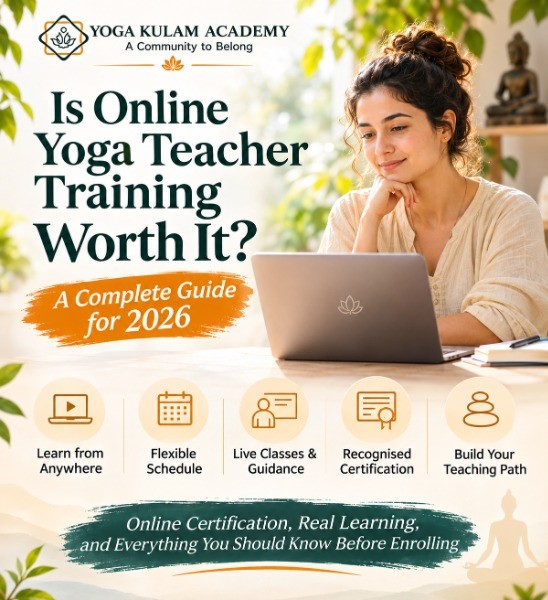
 Understanding Online Yoga Certification, Learning Quality, Career Opportunities, and What to Consider Before EnrollingA few years ago, the idea of becoming a certified yoga teacher without attending a physical yoga school raised plenty of questions.Could students really learn alignment through a screen? Would online certification be recognised? How could someone develop teaching confidence without standing in front of a classroom?These are still reasonable concerns.But online yoga education has developed considerably, and in 2026, students have more choices than simply watching prerecorded videos.Some programs offer live classes, structured assignments, practical teaching assessments, teacher feedback, and opportunities to interact with other students.Still, not every online course provides the same experience.So, is online yoga teacher training actually worth it?The answer depends on what you want to learn, how the program is designed, and how seriously you are prepared to participate.What Is Online Yoga Teacher Training?Online yoga teacher training is a structured educational program that allows students to study yoga remotely.Depending on the school, training may include live video classes, recorded lectures, guided practice, reading materials, assignments, and teaching assessments.A comprehensive yoga teacher training course online generally introduces subjects such as asana, pranayama, meditation, yoga philosophy, anatomy, sequencing, and teaching methodology.The important distinction is between watching yoga videos and participating in teacher education.A regular online yoga class teaches you to practise.Teacher training should also teach you to understand, explain, adapt, and responsibly guide that practice for others.Can You Become a Certified Yoga Teacher Online in 2026?Yes, provided the training meets the requirements of the relevant certifying organisation.Yoga Alliance currently permits Registered Yoga Schools to offer programs entirely online, in person, or through blended learning.For distance learning, Yoga Alliance requires at least 15% of the program hours to involve synchronous learning, meaning teachers and students interact in real time.For a 200-hour program, that means at least 30 live hours.Completing an eligible 200-hour program at an appropriately registered school can satisfy the educational requirement for RYT 200 registration, subject to Yoga Alliance's applicable registration requirements.However, receiving a course certificate and registering as an RYT 200 are separate steps.Before enrolling in a 200 Hour Online Yoga Teacher Training & Certification program, verify the school's current registration, the course's eligibility, and whether additional registration fees apply.A certificate should represent actual learning, not merely completion of video lessons.Why Students Choose Online TrainingThe most obvious advantage is accessibility.Not everyone can leave their job, family, or daily responsibilities to spend a month at a residential yoga school.Travel expenses, accommodation, personal commitments, and geographical distance can make traditional training difficult.An online course allows students to study from home while maintaining much of their existing routine.For someone living in another country, studying with teachers based in India may become possible without international travel.But convenience should not be confused with reduced commitment.A meaningful 200 Hour Online Yoga TTC still requires regular attendance, independent practice, study, assignments, and active participation.The location changes.The responsibility to learn does not.Live Classes Make a Real DifferenceOne of the most important things to consider is how much direct interaction the course provides.Watching an experienced teacher demonstrate a posture can be helpful.But watching is not the same as receiving feedback.During live sessions, students can ask questions, clarify instructions, discuss philosophy, and demonstrate teaching techniques.Teachers may also observe visible aspects of posture and movement, although camera angles and screen limitations mean online observation cannot replace every aspect of in-person assessment.When considering a yoga teacher course online, ask whether the program includes supervised teaching practice.You should have opportunities to explain postures, guide short sequences, receive constructive feedback, and improve your communication.These experiences matter far more than simply having access to hundreds of recorded videos.Can You Learn Proper Alignment Online?Yes, online education can teach useful principles of anatomy, movement, and alignment.However, it comes with limitations.A teacher may not see your entire body clearly through a camera.Subtle compensations can be difficult to observe.Physical assistance is unavailable.And students may find it harder to understand certain instructions without direct demonstration or individual feedback.This does not make online training ineffective.It means the course needs thoughtful teaching methods.Multiple camera angles, clear demonstrations, verbal explanations, props, modifications, and opportunities for feedback can all help.Students should also be encouraged to recognise discomfort, avoid forcing postures, and seek appropriate in-person guidance when necessary.What Should a Good 200-Hour Course Include?A 200-Hour Yoga Teacher Training Course should offer more than a large collection of asana tutorials.Students need a balanced understanding of yoga.Physical practice should be connected with anatomy and alignment.Pranayama should include appropriate techniques and safety considerations.Philosophy should introduce the cultural and historical foundations of yoga rather than treating it only as physical exercise.Teaching methodology should cover sequencing, communication, observation, modifications, ethics, and professional responsibility.Perhaps most importantly, students should have opportunities to practise teaching.Knowing how to perform a posture does not automatically mean you know how to teach it.That ability develops through instruction, observation, feedback, and repetition.Online Training Requires Self-DisciplineThis is one aspect students sometimes underestimate.In a residential yoga school, much of the daily structure is already provided.Classes begin at fixed times.Teachers and classmates are physically present.The environment naturally encourages participation.At home, distractions are harder to avoid.Messages arrive.Family responsibilities interrupt.Work commitments compete for attention.For this reason, a 200-Hour Yoga Teacher Training Course Online may require considerable self-discipline.Creating a dedicated practice space, following a timetable, taking notes, and reviewing lessons between sessions can make the learning experience more effective.Students who approach online training casually may struggle, regardless of the school's reputation.Is Online Yoga Training Better Than Residential Training?Neither format is automatically better.Residential training offers the experience of living within a structured yoga-learning environment.Students often benefit from face-to-face interaction, immediate guidance, shared practice, and fewer everyday distractions.Online training provides greater flexibility and removes many travel-related barriers.It also allows students to apply their learning in their normal surroundings.For example, maintaining a regular yoga routine while working may teach discipline that continues beyond graduation.The ideal choice depends on your learning preferences, circumstances, budget, and goals.If you value physical interaction and complete immersion, residential training may suit you better.If you need accessibility and flexibility while still wanting structured education, online training may be a practical option.Can Online Training Lead to a Yoga Teaching Career?Online training can provide an educational foundation for beginning a teaching journey.But certification alone does not guarantee employment, students, or a successful yoga business.After graduating, new teachers still need practical experience.They must learn how to manage classes, communicate clearly, adapt sequences, and work with students of different abilities.Some graduates begin by teaching friends or small groups.Others assist experienced instructors, continue practising, or seek further mentorship.Whether you train online or in person, confidence develops through experience.It is also worth checking the hiring requirements of studios, employers, insurers, and organisations in the country where you intend to teach.What Comes After 200-Hour Certification?A 200-hour course is a foundation, not the completion of yoga education.Some graduates continue studying anatomy, philosophy, meditation, or specialised teaching approaches.Others pursue advanced qualifications.An Online 300-hour yoga teacher training course can provide an opportunity for graduates of a 200-hour foundation program to deepen their knowledge and develop more advanced teaching skills.For students following the Yoga Alliance pathway, completing eligible 200-hour and 300-hour training can contribute toward the educational requirements for RYT 500 registration, alongside any applicable additional requirements.However, advanced education is most useful when combined with continued personal practice and teaching experience.More training hours should represent deeper learning, not simply another certificate.How to Choose the Right Online Yoga SchoolBefore paying for a course, take time to investigate what is actually included.Consider these questions:Is the school currently registered with the relevant accreditation organisation?How many hours involve live interaction?Who teaches the course, and what are their qualifications?Are practical teaching sessions and assessments included?Can students ask questions and receive feedback?Are recorded sessions available for revision?Does the syllabus cover philosophy, anatomy, pranayama, and teaching methodology?What are the attendance, examination, certification, and refund policies?Avoid choosing a course solely because it promises quick certification or advertises a large discount.A lower price may be attractive, but the quality of education and opportunities for practical learning should carry more weight.Learning Online With Yogakulam AcademyYogakulam Academy offers online yoga teacher training for students who want structured yoga education without travelling to India.Its online 200-hour training brings together subjects such as yoga practice, philosophy, pranayama, meditation, anatomy, and teaching methodology.Live sessions and recorded class access can help students participate in scheduled learning and revisit material for revision, subject to the program's access terms.For students considering an online learning pathway, the goal should be to develop a useful foundation that continues beyond the training period.Explore Yogakulam Academy's online yoga teacher training programs at www.yogakulam.com.Final Verdict: Is Online Yoga Teacher Training Worth It in 2026?Yes, online yoga teacher training can be worth it.But the value comes from the quality of the program and how actively you participate—not simply from learning through a screen.A well-designed course can provide structured education, access to experienced teachers, practical assignments, live feedback, and recognised training credentials where eligibility requirements are met.At the same time, online training has limitations that students should understand, particularly around physical observation and hands-on guidance.The right course should be transparent about both its strengths and its limitations.Ultimately, yoga teacher training is not about completing hours as quickly as possible.It is about developing the understanding, responsibility, and confidence to continue learning and eventually guide others.The certificate may be your first milestone, but your real education continues every time you step onto the mat.
 Understanding Online Yoga Certification, Learning Quality, Career Opportunities, and What to Consider Before EnrollingA few years ago, the idea of becoming a certified yoga teacher without attending a physical yoga school raised plenty of questions.Could students really learn alignment through a screen? Would online certification be recognised? How could someone develop teaching confidence without standing in front of a classroom?These are still reasonable concerns.But online yoga education has developed considerably, and in 2026, students have more choices than simply watching prerecorded videos.Some programs offer live classes, structured assignments, practical teaching assessments, teacher feedback, and opportunities to interact with other students.Still, not every online course provides the same experience.So, is online yoga teacher training actually worth it?The answer depends on what you want to learn, how the program is designed, and how seriously you are prepared to participate.What Is Online Yoga Teacher Training?Online yoga teacher training is a structured educational program that allows students to study yoga remotely.Depending on the school, training may include live video classes, recorded lectures, guided practice, reading materials, assignments, and teaching assessments.A comprehensive yoga teacher training course online generally introduces subjects such as asana, pranayama, meditation, yoga philosophy, anatomy, sequencing, and teaching methodology.The important distinction is between watching yoga videos and participating in teacher education.A regular online yoga class teaches you to practise.Teacher training should also teach you to understand, explain, adapt, and responsibly guide that practice for others.Can You Become a Certified Yoga Teacher Online in 2026?Yes, provided the training meets the requirements of the relevant certifying organisation.Yoga Alliance currently permits Registered Yoga Schools to offer programs entirely online, in person, or through blended learning.For distance learning, Yoga Alliance requires at least 15% of the program hours to involve synchronous learning, meaning teachers and students interact in real time.For a 200-hour program, that means at least 30 live hours.Completing an eligible 200-hour program at an appropriately registered school can satisfy the educational requirement for RYT 200 registration, subject to Yoga Alliance's applicable registration requirements.However, receiving a course certificate and registering as an RYT 200 are separate steps.Before enrolling in a 200 Hour Online Yoga Teacher Training & Certification program, verify the school's current registration, the course's eligibility, and whether additional registration fees apply.A certificate should represent actual learning, not merely completion of video lessons.Why Students Choose Online TrainingThe most obvious advantage is accessibility.Not everyone can leave their job, family, or daily responsibilities to spend a month at a residential yoga school.Travel expenses, accommodation, personal commitments, and geographical distance can make traditional training difficult.An online course allows students to study from home while maintaining much of their existing routine.For someone living in another country, studying with teachers based in India may become possible without international travel.But convenience should not be confused with reduced commitment.A meaningful 200 Hour Online Yoga TTC still requires regular attendance, independent practice, study, assignments, and active participation.The location changes.The responsibility to learn does not.Live Classes Make a Real DifferenceOne of the most important things to consider is how much direct interaction the course provides.Watching an experienced teacher demonstrate a posture can be helpful.But watching is not the same as receiving feedback.During live sessions, students can ask questions, clarify instructions, discuss philosophy, and demonstrate teaching techniques.Teachers may also observe visible aspects of posture and movement, although camera angles and screen limitations mean online observation cannot replace every aspect of in-person assessment.When considering a yoga teacher course online, ask whether the program includes supervised teaching practice.You should have opportunities to explain postures, guide short sequences, receive constructive feedback, and improve your communication.These experiences matter far more than simply having access to hundreds of recorded videos.Can You Learn Proper Alignment Online?Yes, online education can teach useful principles of anatomy, movement, and alignment.However, it comes with limitations.A teacher may not see your entire body clearly through a camera.Subtle compensations can be difficult to observe.Physical assistance is unavailable.And students may find it harder to understand certain instructions without direct demonstration or individual feedback.This does not make online training ineffective.It means the course needs thoughtful teaching methods.Multiple camera angles, clear demonstrations, verbal explanations, props, modifications, and opportunities for feedback can all help.Students should also be encouraged to recognise discomfort, avoid forcing postures, and seek appropriate in-person guidance when necessary.What Should a Good 200-Hour Course Include?A 200-Hour Yoga Teacher Training Course should offer more than a large collection of asana tutorials.Students need a balanced understanding of yoga.Physical practice should be connected with anatomy and alignment.Pranayama should include appropriate techniques and safety considerations.Philosophy should introduce the cultural and historical foundations of yoga rather than treating it only as physical exercise.Teaching methodology should cover sequencing, communication, observation, modifications, ethics, and professional responsibility.Perhaps most importantly, students should have opportunities to practise teaching.Knowing how to perform a posture does not automatically mean you know how to teach it.That ability develops through instruction, observation, feedback, and repetition.Online Training Requires Self-DisciplineThis is one aspect students sometimes underestimate.In a residential yoga school, much of the daily structure is already provided.Classes begin at fixed times.Teachers and classmates are physically present.The environment naturally encourages participation.At home, distractions are harder to avoid.Messages arrive.Family responsibilities interrupt.Work commitments compete for attention.For this reason, a 200-Hour Yoga Teacher Training Course Online may require considerable self-discipline.Creating a dedicated practice space, following a timetable, taking notes, and reviewing lessons between sessions can make the learning experience more effective.Students who approach online training casually may struggle, regardless of the school's reputation.Is Online Yoga Training Better Than Residential Training?Neither format is automatically better.Residential training offers the experience of living within a structured yoga-learning environment.Students often benefit from face-to-face interaction, immediate guidance, shared practice, and fewer everyday distractions.Online training provides greater flexibility and removes many travel-related barriers.It also allows students to apply their learning in their normal surroundings.For example, maintaining a regular yoga routine while working may teach discipline that continues beyond graduation.The ideal choice depends on your learning preferences, circumstances, budget, and goals.If you value physical interaction and complete immersion, residential training may suit you better.If you need accessibility and flexibility while still wanting structured education, online training may be a practical option.Can Online Training Lead to a Yoga Teaching Career?Online training can provide an educational foundation for beginning a teaching journey.But certification alone does not guarantee employment, students, or a successful yoga business.After graduating, new teachers still need practical experience.They must learn how to manage classes, communicate clearly, adapt sequences, and work with students of different abilities.Some graduates begin by teaching friends or small groups.Others assist experienced instructors, continue practising, or seek further mentorship.Whether you train online or in person, confidence develops through experience.It is also worth checking the hiring requirements of studios, employers, insurers, and organisations in the country where you intend to teach.What Comes After 200-Hour Certification?A 200-hour course is a foundation, not the completion of yoga education.Some graduates continue studying anatomy, philosophy, meditation, or specialised teaching approaches.Others pursue advanced qualifications.An Online 300-hour yoga teacher training course can provide an opportunity for graduates of a 200-hour foundation program to deepen their knowledge and develop more advanced teaching skills.For students following the Yoga Alliance pathway, completing eligible 200-hour and 300-hour training can contribute toward the educational requirements for RYT 500 registration, alongside any applicable additional requirements.However, advanced education is most useful when combined with continued personal practice and teaching experience.More training hours should represent deeper learning, not simply another certificate.How to Choose the Right Online Yoga SchoolBefore paying for a course, take time to investigate what is actually included.Consider these questions:Is the school currently registered with the relevant accreditation organisation?How many hours involve live interaction?Who teaches the course, and what are their qualifications?Are practical teaching sessions and assessments included?Can students ask questions and receive feedback?Are recorded sessions available for revision?Does the syllabus cover philosophy, anatomy, pranayama, and teaching methodology?What are the attendance, examination, certification, and refund policies?Avoid choosing a course solely because it promises quick certification or advertises a large discount.A lower price may be attractive, but the quality of education and opportunities for practical learning should carry more weight.Learning Online With Yogakulam AcademyYogakulam Academy offers online yoga teacher training for students who want structured yoga education without travelling to India.Its online 200-hour training brings together subjects such as yoga practice, philosophy, pranayama, meditation, anatomy, and teaching methodology.Live sessions and recorded class access can help students participate in scheduled learning and revisit material for revision, subject to the program's access terms.For students considering an online learning pathway, the goal should be to develop a useful foundation that continues beyond the training period.Explore Yogakulam Academy's online yoga teacher training programs at www.yogakulam.com.Final Verdict: Is Online Yoga Teacher Training Worth It in 2026?Yes, online yoga teacher training can be worth it.But the value comes from the quality of the program and how actively you participate—not simply from learning through a screen.A well-designed course can provide structured education, access to experienced teachers, practical assignments, live feedback, and recognised training credentials where eligibility requirements are met.At the same time, online training has limitations that students should understand, particularly around physical observation and hands-on guidance.The right course should be transparent about both its strengths and its limitations.Ultimately, yoga teacher training is not about completing hours as quickly as possible.It is about developing the understanding, responsibility, and confidence to continue learning and eventually guide others.The certificate may be your first milestone, but your real education continues every time you step onto the mat.
Mon, 9 November 26 : 8:11 : yogakulam academy
Visit / Join Group to Reply