


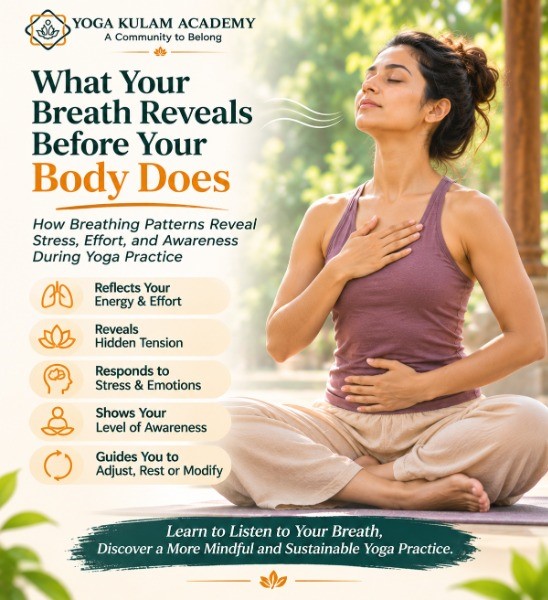
 Understanding How Breathing Patterns Reflect Stress, Effort, Emotional State, and Awareness During Yoga PracticeHave you ever noticed yourself holding your breath while answering a difficult question? Or taking a deep sigh after a stressful conversation?Most of us don't pay much attention to these small moments. We notice our shoulders becoming tense, our bodies feeling tired, or our minds becoming restless. But sometimes, our breathing has already changed long before we recognise what is happening.This becomes particularly interesting during yoga.You might be holding a familiar posture with seemingly perfect alignment, yet your breathing feels hurried. Or you may be performing a simple movement while unconsciously holding your breath.These experiences reveal something important: how a posture looks does not always tell us how the person feels while practising it.Breathing offers another way to observe the relationship between physical effort, attention, and emotional state.Learning to recognise these patterns can make yoga practice more thoughtful and sustainable.Your Breath Responds Before You NoticeBreathing is unusual because it happens automatically, but we can also influence it consciously.When you walk, rest, concentrate, exercise, or experience strong emotions, your breathing naturally changes.During physical effort, breathing may become faster to meet the body's increased demand for oxygen and removal of carbon dioxide.During moments of worry or anticipation, some people begin breathing more rapidly or shallowly.Others unconsciously hold their breath.These reactions are not necessarily signs that something is wrong. They are part of how the body responds to different situations.The interesting part is learning to notice them.In a structured yoga teacher training bengaluru program, breath awareness can help students understand their own responses during practice rather than relying entirely on external posture alignment.A student may look comfortable in an asana while experiencing considerable internal effort.The breath can offer clues worth exploring.Holding Your Breath During Difficult PosturesConsider what happens when you enter a challenging balancing posture.You focus intensely.Your muscles engage.You try not to fall.Then, suddenly, you realise you have stopped breathing.This is common.Some practitioners unconsciously hold their breath when trying to maintain control or stability.But breath-holding can increase the feeling of strain, particularly when combined with strong muscular effort.Learning to maintain comfortable breathing may help students recognise when they are using more effort than necessary.For example, if your breath becomes strained during a standing balance, you might benefit from reducing the difficulty, using support, or briefly returning to a comfortable position.The goal is not to maintain perfectly slow breathing during every challenging movement.It is to avoid unnecessary breath-holding and respond appropriately to your body's needs.Your Breath Can Reveal Unnecessary TensionSometimes a posture feels difficult not because it requires exceptional strength, but because we are using effort in places that do not need it.You might notice yourself clenching your jaw during a forward bend.Lifting your shoulders while balancing.Tightening your face during a seated twist.Or holding your abdomen rigid during a movement that should feel relatively comfortable.These patterns can influence how naturally you breathe.A thoughtful Bengaluru Yoga Teacher Training environment encourages students to observe these details.Instead of simply asking whether a posture looks correct, a teacher can also ask whether the student feels comfortable, can breathe naturally, and is using an appropriate amount of effort.Sometimes relaxing the jaw or reducing muscular tension changes the entire experience of an asana.Stress Often Changes Breathing PatternsThink about the last time you were running late.Perhaps your breathing became faster.Your shoulders tightened.You moved more quickly than usual.Now compare that with a quiet morning when you had nowhere urgent to be.Your breathing may have felt different.Stress can influence respiratory rate, breathing depth, and muscle tension, although these responses vary between individuals.This is why breathing awareness can be useful during yoga and everyday life.It gives you an opportunity to notice how you are responding to a situation.However, breathing patterns should not be treated as a perfect measure of emotional wellbeing.Fast breathing does not always mean anxiety, and slow breathing does not automatically mean someone is relaxed.Context matters.Breathing Changes How You Experience MovementBreathing and movement influence one another.During yoga, coordinating movement with breathing can help create a more organised rhythm.For example, many traditional practices use inhalation during certain movements and exhalation during others.These patterns can support attention and consistency.But breathing instructions should not become rigid rules applied without consideration.A practitioner with respiratory difficulties, limited mobility, or particular health concerns may need modifications.Students exploring the Best yoga teacher training in bangalore should look for programs that teach not only breathing techniques but also their purpose, appropriate application, limitations, and safety considerations.Understanding when to adapt a technique is just as important as knowing how to perform it.What Your Breath Reveals During RepetitionOne of the most valuable things about repeated yoga practice is the opportunity to notice changes.Imagine practising the same standing sequence over several weeks.During the first few sessions, you may become breathless quickly.Later, the sequence may feel more manageable.You might notice that you no longer hold your breath during transitions or that your movements have become more coordinated.These observations may reflect improved familiarity, physical conditioning, or more efficient movement.However, they are not guaranteed signs of improved respiratory health.Breathing is influenced by many factors, including exercise intensity, temperature, fatigue, and medical conditions.The value lies in noticing patterns rather than attaching a fixed meaning to every breath.Pranayama Is More Than Taking Deep BreathsPranayama is sometimes described simply as deep breathing.Traditional yoga, however, includes a much broader range of breathing practices involving awareness, regulation, rhythm, and specific techniques.Not every pranayama practice is suitable for every student.Some techniques are gentle and accessible.Others involve forceful breathing or breath retention and require greater experience and appropriate guidance.In a yoga teacher training bangalore india course, students should learn the differences between observing natural breathing, coordinating breath with movement, and practising formal pranayama techniques.These are related but distinct skills.For beginners, learning to recognise a comfortable natural breathing rhythm is often a useful starting point.There is no need to rush toward advanced breath-control practices.Your Breath Is Not a CompetitionYoga students sometimes become overly concerned with breathing correctly.They may try to make every inhalation longer.They may force slow breathing even when it feels uncomfortable.Or they may compare their breath retention with another student's.This can create unnecessary pressure.Breathing practice should not become another performance.If a breathing technique causes dizziness, discomfort, chest pain, or unusual breathlessness, it should be stopped and the symptoms assessed appropriately.The purpose of breath awareness is to develop understanding, not to prove control.A calm-looking practitioner is not necessarily experiencing comfortable breathing, just as someone breathing faster is not automatically practising incorrectly.Why Yoga Teachers Must Observe More Than AlignmentTeaching yoga involves much more than correcting physical positions.A student may enter a posture easily but struggle to maintain comfortable breathing.Another may move slowly yet remain steady and attentive.A third may look physically capable but feel anxious or overwhelmed.A responsible teacher learns to observe without making assumptions.They can ask students how a movement feels, offer modifications, and encourage comfortable breathing without demanding a particular respiratory pattern.This is an important principle in the best 200-hour Yoga Teacher Training experience.Good teaching requires an understanding of anatomy, movement, breath, communication, and individual differences.It also requires recognising that a teacher cannot diagnose a student's physical or emotional condition merely by watching their breathing.Breath Awareness Beyond the Yoga MatPerhaps the most practical aspect of breathing awareness is that it does not need to end when class finishes.You might notice yourself holding your breath while working on a computer.Breathing rapidly before an important meeting.Taking shallow breaths while concentrating.Or sighing after completing a difficult task.These observations can create an opportunity to check in with yourself.Are you rushing?Are you physically tense?Do you need a short break?Would changing your posture or stepping away from your work help?You do not need to analyse every breath.The aim is simply to become more aware of your habits.Over time, that awareness may help you recognise when to rest, adjust your activity, or practise a comfortable breathing exercise.Learning to Listen Before Pushing FurtherYoga often encourages us to explore our capabilities.But exploration should include recognising limits.If a posture requires so much effort that you repeatedly hold your breath, that may be a reason to modify it.If you feel unusually breathless during a familiar sequence, consider whether fatigue, illness, intensity, or another factor may be involved.Persistent or unexplained breathlessness deserves medical attention rather than being dismissed as a normal part of yoga practice.A thoughtful teacher does not encourage students to ignore these signals.Instead, they help students develop an appropriate relationship with effort, comfort, and self-observation.Final ThoughtsYour breathing can offer valuable information about how you are responding to movement, concentration, physical effort, and everyday stress.It may change before you consciously notice tension or fatigue.But breath is not a perfect diagnostic tool, and no single breathing pattern tells the whole story.The real value of breath awareness lies in curiosity.Instead of asking only, "How deeply can I enter this posture?" you begin asking, "How am I breathing while I am here?"That simple question can change your relationship with yoga.Whether you are practising independently or joining a Bengaluru Yoga Teacher Training program, learning to observe breathing alongside movement can help develop a more attentive approach.Because yoga is not only about what your body can accomplish.It is also about understanding what happens within you while you practise.
 Understanding How Breathing Patterns Reflect Stress, Effort, Emotional State, and Awareness During Yoga PracticeHave you ever noticed yourself holding your breath while answering a difficult question? Or taking a deep sigh after a stressful conversation?Most of us don't pay much attention to these small moments. We notice our shoulders becoming tense, our bodies feeling tired, or our minds becoming restless. But sometimes, our breathing has already changed long before we recognise what is happening.This becomes particularly interesting during yoga.You might be holding a familiar posture with seemingly perfect alignment, yet your breathing feels hurried. Or you may be performing a simple movement while unconsciously holding your breath.These experiences reveal something important: how a posture looks does not always tell us how the person feels while practising it.Breathing offers another way to observe the relationship between physical effort, attention, and emotional state.Learning to recognise these patterns can make yoga practice more thoughtful and sustainable.Your Breath Responds Before You NoticeBreathing is unusual because it happens automatically, but we can also influence it consciously.When you walk, rest, concentrate, exercise, or experience strong emotions, your breathing naturally changes.During physical effort, breathing may become faster to meet the body's increased demand for oxygen and removal of carbon dioxide.During moments of worry or anticipation, some people begin breathing more rapidly or shallowly.Others unconsciously hold their breath.These reactions are not necessarily signs that something is wrong. They are part of how the body responds to different situations.The interesting part is learning to notice them.In a structured yoga teacher training bengaluru program, breath awareness can help students understand their own responses during practice rather than relying entirely on external posture alignment.A student may look comfortable in an asana while experiencing considerable internal effort.The breath can offer clues worth exploring.Holding Your Breath During Difficult PosturesConsider what happens when you enter a challenging balancing posture.You focus intensely.Your muscles engage.You try not to fall.Then, suddenly, you realise you have stopped breathing.This is common.Some practitioners unconsciously hold their breath when trying to maintain control or stability.But breath-holding can increase the feeling of strain, particularly when combined with strong muscular effort.Learning to maintain comfortable breathing may help students recognise when they are using more effort than necessary.For example, if your breath becomes strained during a standing balance, you might benefit from reducing the difficulty, using support, or briefly returning to a comfortable position.The goal is not to maintain perfectly slow breathing during every challenging movement.It is to avoid unnecessary breath-holding and respond appropriately to your body's needs.Your Breath Can Reveal Unnecessary TensionSometimes a posture feels difficult not because it requires exceptional strength, but because we are using effort in places that do not need it.You might notice yourself clenching your jaw during a forward bend.Lifting your shoulders while balancing.Tightening your face during a seated twist.Or holding your abdomen rigid during a movement that should feel relatively comfortable.These patterns can influence how naturally you breathe.A thoughtful Bengaluru Yoga Teacher Training environment encourages students to observe these details.Instead of simply asking whether a posture looks correct, a teacher can also ask whether the student feels comfortable, can breathe naturally, and is using an appropriate amount of effort.Sometimes relaxing the jaw or reducing muscular tension changes the entire experience of an asana.Stress Often Changes Breathing PatternsThink about the last time you were running late.Perhaps your breathing became faster.Your shoulders tightened.You moved more quickly than usual.Now compare that with a quiet morning when you had nowhere urgent to be.Your breathing may have felt different.Stress can influence respiratory rate, breathing depth, and muscle tension, although these responses vary between individuals.This is why breathing awareness can be useful during yoga and everyday life.It gives you an opportunity to notice how you are responding to a situation.However, breathing patterns should not be treated as a perfect measure of emotional wellbeing.Fast breathing does not always mean anxiety, and slow breathing does not automatically mean someone is relaxed.Context matters.Breathing Changes How You Experience MovementBreathing and movement influence one another.During yoga, coordinating movement with breathing can help create a more organised rhythm.For example, many traditional practices use inhalation during certain movements and exhalation during others.These patterns can support attention and consistency.But breathing instructions should not become rigid rules applied without consideration.A practitioner with respiratory difficulties, limited mobility, or particular health concerns may need modifications.Students exploring the Best yoga teacher training in bangalore should look for programs that teach not only breathing techniques but also their purpose, appropriate application, limitations, and safety considerations.Understanding when to adapt a technique is just as important as knowing how to perform it.What Your Breath Reveals During RepetitionOne of the most valuable things about repeated yoga practice is the opportunity to notice changes.Imagine practising the same standing sequence over several weeks.During the first few sessions, you may become breathless quickly.Later, the sequence may feel more manageable.You might notice that you no longer hold your breath during transitions or that your movements have become more coordinated.These observations may reflect improved familiarity, physical conditioning, or more efficient movement.However, they are not guaranteed signs of improved respiratory health.Breathing is influenced by many factors, including exercise intensity, temperature, fatigue, and medical conditions.The value lies in noticing patterns rather than attaching a fixed meaning to every breath.Pranayama Is More Than Taking Deep BreathsPranayama is sometimes described simply as deep breathing.Traditional yoga, however, includes a much broader range of breathing practices involving awareness, regulation, rhythm, and specific techniques.Not every pranayama practice is suitable for every student.Some techniques are gentle and accessible.Others involve forceful breathing or breath retention and require greater experience and appropriate guidance.In a yoga teacher training bangalore india course, students should learn the differences between observing natural breathing, coordinating breath with movement, and practising formal pranayama techniques.These are related but distinct skills.For beginners, learning to recognise a comfortable natural breathing rhythm is often a useful starting point.There is no need to rush toward advanced breath-control practices.Your Breath Is Not a CompetitionYoga students sometimes become overly concerned with breathing correctly.They may try to make every inhalation longer.They may force slow breathing even when it feels uncomfortable.Or they may compare their breath retention with another student's.This can create unnecessary pressure.Breathing practice should not become another performance.If a breathing technique causes dizziness, discomfort, chest pain, or unusual breathlessness, it should be stopped and the symptoms assessed appropriately.The purpose of breath awareness is to develop understanding, not to prove control.A calm-looking practitioner is not necessarily experiencing comfortable breathing, just as someone breathing faster is not automatically practising incorrectly.Why Yoga Teachers Must Observe More Than AlignmentTeaching yoga involves much more than correcting physical positions.A student may enter a posture easily but struggle to maintain comfortable breathing.Another may move slowly yet remain steady and attentive.A third may look physically capable but feel anxious or overwhelmed.A responsible teacher learns to observe without making assumptions.They can ask students how a movement feels, offer modifications, and encourage comfortable breathing without demanding a particular respiratory pattern.This is an important principle in the best 200-hour Yoga Teacher Training experience.Good teaching requires an understanding of anatomy, movement, breath, communication, and individual differences.It also requires recognising that a teacher cannot diagnose a student's physical or emotional condition merely by watching their breathing.Breath Awareness Beyond the Yoga MatPerhaps the most practical aspect of breathing awareness is that it does not need to end when class finishes.You might notice yourself holding your breath while working on a computer.Breathing rapidly before an important meeting.Taking shallow breaths while concentrating.Or sighing after completing a difficult task.These observations can create an opportunity to check in with yourself.Are you rushing?Are you physically tense?Do you need a short break?Would changing your posture or stepping away from your work help?You do not need to analyse every breath.The aim is simply to become more aware of your habits.Over time, that awareness may help you recognise when to rest, adjust your activity, or practise a comfortable breathing exercise.Learning to Listen Before Pushing FurtherYoga often encourages us to explore our capabilities.But exploration should include recognising limits.If a posture requires so much effort that you repeatedly hold your breath, that may be a reason to modify it.If you feel unusually breathless during a familiar sequence, consider whether fatigue, illness, intensity, or another factor may be involved.Persistent or unexplained breathlessness deserves medical attention rather than being dismissed as a normal part of yoga practice.A thoughtful teacher does not encourage students to ignore these signals.Instead, they help students develop an appropriate relationship with effort, comfort, and self-observation.Final ThoughtsYour breathing can offer valuable information about how you are responding to movement, concentration, physical effort, and everyday stress.It may change before you consciously notice tension or fatigue.But breath is not a perfect diagnostic tool, and no single breathing pattern tells the whole story.The real value of breath awareness lies in curiosity.Instead of asking only, "How deeply can I enter this posture?" you begin asking, "How am I breathing while I am here?"That simple question can change your relationship with yoga.Whether you are practising independently or joining a Bengaluru Yoga Teacher Training program, learning to observe breathing alongside movement can help develop a more attentive approach.Because yoga is not only about what your body can accomplish.It is also about understanding what happens within you while you practise.
Fri, 6 November 26 : 5:11 : yogakulam academy
Visit / Join Group to Reply