


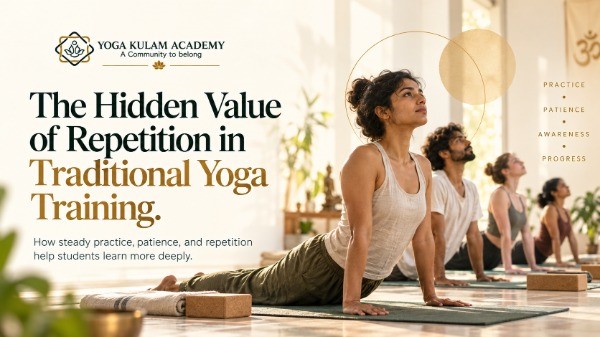
 In a world that constantly pushes us toward something new, repetition can feel unexciting.A new pose seems more interesting than repeating the same standing sequence. A new workshop feels more attractive than practising the same breathing technique again. Many students begin yoga with the idea that progress means adding more.More poses.More techniques.More complexity.Traditional yoga often teaches the opposite.One of its most valuable lessons is that real progress often comes from doing the same thing again and again, with more awareness each time.Repetition is not a lack of progress. In many cases, it is the method through which progress happens.Repetition Builds Understanding, Not Just MemoryWhen a student first learns a posture, most of their attention goes toward the obvious things.Where should the hands go?How far should the feet be apart?Which direction should the body face?What should happen with the breath?At this stage, the student is mainly trying to remember the shape.But after repeating the posture many times, something changes.The basic structure becomes familiar. That frees the mind to notice more subtle details.The student begins to observe the distribution of weight, unnecessary tension, breath quality, balance, concentration, and how the posture feels on different days.This is one reason repetition plays such an important role in Hatha Ashtanga yoga teacher training Mysore programs. Students are not simply collecting techniques. They are learning to observe the same practices with increasing depth.The Same Practice Is Never Exactly the SameOne of the most interesting things about repetition in yoga is that the practice may stay the same while the practitioner changes.A posture that feels easy one morning may feel difficult the next.A breathing exercise that once felt uncomfortable may eventually become calming.A meditation that seemed boring in the first week may later reveal how restless the mind actually is.The technique has not necessarily changed.Your awareness has.This is one of the quieter lessons of traditional yoga.Repeating a practice gives you a point of comparison. Without repetition, it is difficult to know whether your body, breathing, focus, or attitude is actually changing.Repetition Develops SensitivityBeginners often look for dramatic sensations.A deep stretch.A difficult balance.A challenging backbend.But experienced practitioners usually become more interested in subtler information.Can I breathe comfortably here?Am I gripping my jaw?Is my weight evenly distributed?Am I forcing the posture?What happens if I use slightly less effort?This sensitivity develops through repetition.When the sequence is familiar, the student no longer has to spend all their attention wondering what comes next. They can begin to pay attention to what is happening now.That is where yoga becomes less about performing movements and more about developing awareness.Why Traditional Training Does Not Constantly Change the SequenceStudents coming from modern fitness environments sometimes expect every class to be different.New sequence.New theme.New challenge.That can certainly keep classes entertaining, but traditional training often uses a different approach.Certain practices are repeated intentionally.This gives the teacher an opportunity to observe the student over time.Is the alignment improving?Is the breathing more stable?Is the student becoming more patient?Are they still making the same mistake?When comparing the top yoga schools in Mysore for teacher training, it can be useful to look at how the program balances variety with repetition. A strong training should expose students to different areas of yoga, but it should also give enough time to practise important techniques repeatedly.Otherwise, students may finish knowing many things superficially but very few things well.Repetition Helps the Body LearnNot all learning happens intellectually.The body learns too.You may understand an alignment instruction immediately in theory, but it can take many repetitions before the body naturally responds.This is sometimes called motor learning.Through repeated practice, movements become more coordinated and efficient.The student begins to use less unnecessary effort.Transitions become smoother.Balance improves.Breathing becomes more consistent.This is especially important in teacher training because future teachers need more than theoretical knowledge.They need enough familiarity with the practice that they can observe other students while remaining grounded in their own understanding.Repetition Reveals HabitsOne of the hidden benefits of doing the same practice repeatedly is that your habits become harder to ignore.Perhaps you always rush through transitions.Perhaps you avoid difficult postures.Perhaps you become frustrated when progress is slow.Perhaps you push harder whenever you feel insecure.You may not notice these patterns during a constantly changing class.But repetition exposes them.Traditional yoga is not only interested in what the body can do. It is also interesting in how the mind behaves.This is where repetition becomes a form of self-study.Why This Matters During Teacher TrainingA teacher needs to recognise patterns.That includes patterns in posture, breathing, attention, effort, and behaviour.Repeated practice gives trainees time to develop this observation.For example, the first time a trainee practises teaching Trikonasana, they may simply remember the basic instructions.After teaching it several times, they begin to notice more.One student may collapse into the shoulder.Another may lock the knee.Someone else may be holding the breath.The trainee gradually learns how to observe, communicate, and adapt.This cannot be developed through memorisation alone.It requires repetition.This is part of what students should look for when searching for the best Yoga Teacher Training Mysore experience: not just how much content is included, but how much time is given to practising, teaching, receiving feedback, and trying again.Repetition Is Also Important in Pranayama and MeditationThe value of repetition is even clearer in pranayama and meditation.These practices rarely produce dramatic results in one session.Their effects are often gradual.A student may need several days just to become comfortable with the technique.Then several more to observe the breath without controlling it too much.Later, they may begin to notice changes in concentration, emotional state, or breathing patterns.The same applies to meditation.Repeating a simple practice can initially feel uneventful.But over time, students may become more aware of thought patterns, restlessness, impatience, or calm.Without repetition, these changes are easy to miss.Repetition Does Not Mean Mechanical PracticeThere is an important difference between repetition and mindless repetition.Doing the same sequence while mentally absent is not the goal.Traditional practice asks for renewed attention each time.The posture may be familiar, but the observation should remain fresh.How do I feel today?What has changed?What needs less effort?What needs more stability?This turns repetition into inquiry.Instead of asking, “Why am I doing this again?” the student begins to ask, “What can I notice this time?”That shift changes the entire experience.Why Repetition Can Feel UncomfortableRepetition can challenge the ego.Novelty gives us the feeling that we are progressing quickly.Repetition can make progress feel slower.You cannot hide behind new techniques when you are repeatedly returning to the same fundamentals.You begin to see clearly where you are improving and where you are not.That can be frustrating, but it can also be honest.Traditional yoga often values this honesty more than constant excitement.Repetition in a Yoga Retreat SettingThe same principle applies outside formal teacher training.During a yoga retreat in Mysore, repeating a simple daily rhythm can become part of the experience.Morning practice.Breathwork.Meals at regular times.Meditation.Rest.Evening reflection.At first, the routine may feel repetitive.After several days, it can begin to feel grounding.The mind spends less energy making decisions, and more attention becomes available for the practice itself.This is one reason a longer yoga retreat in Mysore can feel very different from attending occasional classes at home.The repetition creates continuity.And continuity often creates depth.Traditional Yoga Values FoundationsAdvanced practice is often built on very simple things.Breathing steadily.Standing with awareness.Moving without unnecessary tension.Sitting comfortably.Observing the mind.These skills may not look impressive, but they support everything else.The student who constantly searches for something new may miss them.The student who is willing to repeat them has a chance to understand them more deeply.Final ThoughtsRepetition in traditional yoga is not about doing something because the teacher ran out of ideas.It is deliberate.It allows the body to learn, the mind to observe, and the student to notice changes that are invisible during constantly changing practice.In Hatha Ashtanga yoga teacher training Mysore, repetition can help students move from simply remembering instructions to genuinely understanding them.When comparing the top yoga schools in Mysore for teacher training, this is worth paying attention to.Ask how much practical repetition is included.Ask whether students teach more than once.Ask whether important techniques are revisited.Ask whether the course gives students enough time to go deeper instead of constantly moving on.The most valuable yoga practices are not always the newest or most complicated.Sometimes they are the ones you have done a hundred times—and finally begin to understand.
 In a world that constantly pushes us toward something new, repetition can feel unexciting.A new pose seems more interesting than repeating the same standing sequence. A new workshop feels more attractive than practising the same breathing technique again. Many students begin yoga with the idea that progress means adding more.More poses.More techniques.More complexity.Traditional yoga often teaches the opposite.One of its most valuable lessons is that real progress often comes from doing the same thing again and again, with more awareness each time.Repetition is not a lack of progress. In many cases, it is the method through which progress happens.Repetition Builds Understanding, Not Just MemoryWhen a student first learns a posture, most of their attention goes toward the obvious things.Where should the hands go?How far should the feet be apart?Which direction should the body face?What should happen with the breath?At this stage, the student is mainly trying to remember the shape.But after repeating the posture many times, something changes.The basic structure becomes familiar. That frees the mind to notice more subtle details.The student begins to observe the distribution of weight, unnecessary tension, breath quality, balance, concentration, and how the posture feels on different days.This is one reason repetition plays such an important role in Hatha Ashtanga yoga teacher training Mysore programs. Students are not simply collecting techniques. They are learning to observe the same practices with increasing depth.The Same Practice Is Never Exactly the SameOne of the most interesting things about repetition in yoga is that the practice may stay the same while the practitioner changes.A posture that feels easy one morning may feel difficult the next.A breathing exercise that once felt uncomfortable may eventually become calming.A meditation that seemed boring in the first week may later reveal how restless the mind actually is.The technique has not necessarily changed.Your awareness has.This is one of the quieter lessons of traditional yoga.Repeating a practice gives you a point of comparison. Without repetition, it is difficult to know whether your body, breathing, focus, or attitude is actually changing.Repetition Develops SensitivityBeginners often look for dramatic sensations.A deep stretch.A difficult balance.A challenging backbend.But experienced practitioners usually become more interested in subtler information.Can I breathe comfortably here?Am I gripping my jaw?Is my weight evenly distributed?Am I forcing the posture?What happens if I use slightly less effort?This sensitivity develops through repetition.When the sequence is familiar, the student no longer has to spend all their attention wondering what comes next. They can begin to pay attention to what is happening now.That is where yoga becomes less about performing movements and more about developing awareness.Why Traditional Training Does Not Constantly Change the SequenceStudents coming from modern fitness environments sometimes expect every class to be different.New sequence.New theme.New challenge.That can certainly keep classes entertaining, but traditional training often uses a different approach.Certain practices are repeated intentionally.This gives the teacher an opportunity to observe the student over time.Is the alignment improving?Is the breathing more stable?Is the student becoming more patient?Are they still making the same mistake?When comparing the top yoga schools in Mysore for teacher training, it can be useful to look at how the program balances variety with repetition. A strong training should expose students to different areas of yoga, but it should also give enough time to practise important techniques repeatedly.Otherwise, students may finish knowing many things superficially but very few things well.Repetition Helps the Body LearnNot all learning happens intellectually.The body learns too.You may understand an alignment instruction immediately in theory, but it can take many repetitions before the body naturally responds.This is sometimes called motor learning.Through repeated practice, movements become more coordinated and efficient.The student begins to use less unnecessary effort.Transitions become smoother.Balance improves.Breathing becomes more consistent.This is especially important in teacher training because future teachers need more than theoretical knowledge.They need enough familiarity with the practice that they can observe other students while remaining grounded in their own understanding.Repetition Reveals HabitsOne of the hidden benefits of doing the same practice repeatedly is that your habits become harder to ignore.Perhaps you always rush through transitions.Perhaps you avoid difficult postures.Perhaps you become frustrated when progress is slow.Perhaps you push harder whenever you feel insecure.You may not notice these patterns during a constantly changing class.But repetition exposes them.Traditional yoga is not only interested in what the body can do. It is also interesting in how the mind behaves.This is where repetition becomes a form of self-study.Why This Matters During Teacher TrainingA teacher needs to recognise patterns.That includes patterns in posture, breathing, attention, effort, and behaviour.Repeated practice gives trainees time to develop this observation.For example, the first time a trainee practises teaching Trikonasana, they may simply remember the basic instructions.After teaching it several times, they begin to notice more.One student may collapse into the shoulder.Another may lock the knee.Someone else may be holding the breath.The trainee gradually learns how to observe, communicate, and adapt.This cannot be developed through memorisation alone.It requires repetition.This is part of what students should look for when searching for the best Yoga Teacher Training Mysore experience: not just how much content is included, but how much time is given to practising, teaching, receiving feedback, and trying again.Repetition Is Also Important in Pranayama and MeditationThe value of repetition is even clearer in pranayama and meditation.These practices rarely produce dramatic results in one session.Their effects are often gradual.A student may need several days just to become comfortable with the technique.Then several more to observe the breath without controlling it too much.Later, they may begin to notice changes in concentration, emotional state, or breathing patterns.The same applies to meditation.Repeating a simple practice can initially feel uneventful.But over time, students may become more aware of thought patterns, restlessness, impatience, or calm.Without repetition, these changes are easy to miss.Repetition Does Not Mean Mechanical PracticeThere is an important difference between repetition and mindless repetition.Doing the same sequence while mentally absent is not the goal.Traditional practice asks for renewed attention each time.The posture may be familiar, but the observation should remain fresh.How do I feel today?What has changed?What needs less effort?What needs more stability?This turns repetition into inquiry.Instead of asking, “Why am I doing this again?” the student begins to ask, “What can I notice this time?”That shift changes the entire experience.Why Repetition Can Feel UncomfortableRepetition can challenge the ego.Novelty gives us the feeling that we are progressing quickly.Repetition can make progress feel slower.You cannot hide behind new techniques when you are repeatedly returning to the same fundamentals.You begin to see clearly where you are improving and where you are not.That can be frustrating, but it can also be honest.Traditional yoga often values this honesty more than constant excitement.Repetition in a Yoga Retreat SettingThe same principle applies outside formal teacher training.During a yoga retreat in Mysore, repeating a simple daily rhythm can become part of the experience.Morning practice.Breathwork.Meals at regular times.Meditation.Rest.Evening reflection.At first, the routine may feel repetitive.After several days, it can begin to feel grounding.The mind spends less energy making decisions, and more attention becomes available for the practice itself.This is one reason a longer yoga retreat in Mysore can feel very different from attending occasional classes at home.The repetition creates continuity.And continuity often creates depth.Traditional Yoga Values FoundationsAdvanced practice is often built on very simple things.Breathing steadily.Standing with awareness.Moving without unnecessary tension.Sitting comfortably.Observing the mind.These skills may not look impressive, but they support everything else.The student who constantly searches for something new may miss them.The student who is willing to repeat them has a chance to understand them more deeply.Final ThoughtsRepetition in traditional yoga is not about doing something because the teacher ran out of ideas.It is deliberate.It allows the body to learn, the mind to observe, and the student to notice changes that are invisible during constantly changing practice.In Hatha Ashtanga yoga teacher training Mysore, repetition can help students move from simply remembering instructions to genuinely understanding them.When comparing the top yoga schools in Mysore for teacher training, this is worth paying attention to.Ask how much practical repetition is included.Ask whether students teach more than once.Ask whether important techniques are revisited.Ask whether the course gives students enough time to go deeper instead of constantly moving on.The most valuable yoga practices are not always the newest or most complicated.Sometimes they are the ones you have done a hundred times—and finally begin to understand.
Fri, 30 October 26 : 5:10 : yogakulam academy
Visit / Join Group to Reply