


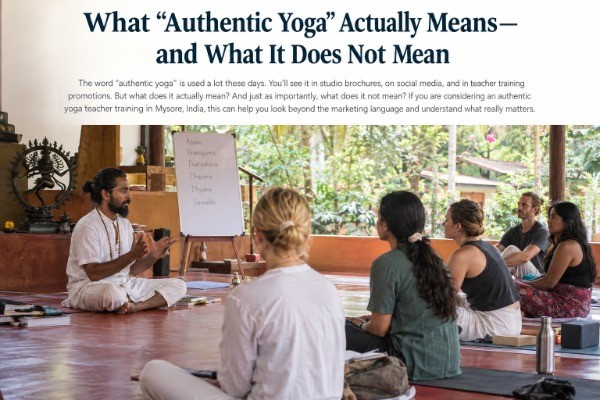
 The word “authentic” gets used a lot in yoga.You see it on websites, retreat pages, teacher training brochures, Instagram posts, and course descriptions. Everyone seems to offer “authentic yoga,” but very few people stop to explain what that actually means.Does authentic yoga mean practising in India? Does it mean learning Sanskrit? Does it mean following one traditional lineage? Does it mean doing fewer modern poses? Or does it simply mean practising with sincerity?The truth is more nuanced.Authentic yoga is not about copying the past exactly. It is about understanding where the practice comes from, respecting its depth, and learning in a way that goes beyond the physical shapes of asana.That is why students looking for an authentic yoga teacher training Mysore India often find that the most meaningful part of the experience is not the certificate or the number of postures learned. It is the way yoga becomes part of daily life.Authentic Yoga Is More Than AsanaFor many people, yoga begins with physical practice.That is completely normal.A person may first come to yoga because of back pain, flexibility, stress, fitness, or curiosity. But traditional yoga has always been broader than physical movement.Asana is only one part.Breathwork, meditation, concentration, philosophy, self-discipline, ethical awareness, rest, and reflection are also part of the larger system.A training that only teaches poses may still be useful, but it would be difficult to call it a complete introduction to traditional yoga.This is one reason students exploring a certified yoga teacher training India Mysore should look carefully at the curriculum rather than only the photos or certification logo.The real question is: what are you actually being taught?Authentic Does Not Mean Old-FashionedThere is a common misunderstanding that “authentic” means refusing anything modern.That is not realistic.Yoga has always changed depending on the teacher, student, time, and place.A modern yoga teacher may use anatomy terms, digital presentations, contemporary teaching methods, or props. None of that automatically makes the practice less authentic.Authenticity is more about whether the core principles are respected.A good teacher should be able to explain why a practice is done, what tradition it comes from, and how it can be adapted responsibly.Using a projector in a philosophy class does not make the teaching inauthentic.Claiming that yoga can cure every disease probably does.Authentic Yoga Does Not Require PerfectionSometimes yoga is presented as though a “real” practitioner must wake up at 4 a.m., eat perfectly, meditate for hours, and never feel stressed.That image can make yoga feel unrealistic.Authentic practice is not about becoming a perfect person.It is about becoming more aware.You may still get irritated.You may still miss practice.You may still have days when your body feels stiff and your mind feels distracted.The point is not to pretend otherwise.The point is to notice.That honesty is often more meaningful than performing the image of a spiritual lifestyle. Why Mysore Is So Closely Linked With Traditional YogaMysore has a unique place in modern yoga history.The city is closely associated with teachers who influenced how yoga is practised around the world, particularly through the development of Ashtanga Yoga and structured methods of practice.This history still shapes the atmosphere of yoga learning in the city today.Students travel to Mysore because they want more than a drop-in class.They want immersion.A Hatha Ashtanga yoga teacher training Mysore program often gives students the chance to practise regularly, study philosophy, learn pranayama, understand alignment, explore meditation, and experience a more disciplined daily routine.That routine is part of the learning.You begin to understand that yoga is not only what happens during class.It is also how you sleep, eat, recover, speak, observe, and respond.Authentic Yoga Is Not About ExoticismThis point is important.Sometimes international wellness marketing makes India look mysterious or exotic in a way that does not reflect real life.Temples, incense, robes, chanting, and traditional architecture can all be meaningful parts of the experience, but they do not automatically make a program authentic.A beautiful setting can still have shallow teaching.A simple classroom can still offer deep learning.Authenticity is not decoration.It is not the presence of a gong, Sanskrit writing on the wall, or a teacher wearing traditional clothing.It comes from the quality of the teaching, the integrity of the practice, and the way knowledge is shared. What Should You Look for in a Teacher Training?If you are comparing the top yoga schools in Mysore for teacher training, it helps to look beyond branding.Start with the teachers.How long have they practised?What subjects do they teach?Do they explain concepts clearly?Can they adapt the practice for different bodies and experience levels?Then look at the curriculum.A balanced teacher training should normally include more than asana.Philosophy, anatomy, pranayama, meditation, teaching methodology, alignment, and practical teaching should all have a place.Class size also matters.A smaller group may allow more time for questions, corrections, and individual guidance.And if the program is residential, the environment matters too.Food, accommodation, rest, and daily routine all influence how much energy you have for learning.Certification Is Useful—but It Is Not the Same as AuthenticityCertification matters.It can provide structure, professional recognition, and a clear educational framework.But certification alone does not tell you whether a course is meaningful.A certified yoga teacher training India Mysore program should still be judged by its teaching quality.A certificate can confirm that you completed a course.It cannot guarantee that you understood the material deeply.That part depends on the learning process.Students sometimes focus so much on “getting certified” that they forget the real purpose of teacher training: becoming a better practitioner and learning how to guide others responsibly.Tradition and Adaptation Can Exist TogetherOne of the most useful things yoga can teach is balance.That applies to tradition too.A teacher can respect classical practices while still understanding modern bodies, injuries, lifestyles, and learning needs.For example, a traditional pose does not need to be forced simply because it was taught a certain way in the past.A responsible teacher can preserve the intention of the practice while offering safer modifications.This is where good teaching becomes important.Tradition should provide roots.It should not become rigid.Authentic Yoga Is Often Less Dramatic Than People ExpectSome of the most meaningful parts of yoga are surprisingly ordinary.Sitting quietly before class.Learning to breathe without forcing.Repeating the same basic posture for weeks.Noticing how quickly you become frustrated.Resting when you would normally push harder.Listening instead of trying to impress.These things are not dramatic enough for social media.But they are often where the real practice begins.Students who join an authentic yoga teacher training Mysore India program may expect transformation to come from advanced poses or intense experiences.Often, it comes from repetition, patience, and consistency.The Teacher-Student Relationship Still MattersOnline learning has made yoga more accessible than ever, which is a good thing.But direct guidance still has value.A teacher can notice things you may not notice yourself.They can correct alignment, answer questions, challenge assumptions, and help you understand when to progress and when to slow down.This is one reason traditional teacher training environments continue to attract students.The relationship between teacher and student is not about blind obedience.It is about learning through observation, conversation, practice, and feedback.That relationship is difficult to replace with information alone. What Authentic Yoga Does Not MeanAuthentic yoga does not mean:- You must be flexible.- You must be Indian.- You must follow one specific school forever.- You must reject modern knowledge.- You must become vegetarian or vegan immediately.- You must perform advanced postures.- You must believe every traditional claim without question.- You must live like a monk.Authenticity is not a costume.It is a relationship with the practice.So, What Does Authentic Yoga Actually Mean?It means learning with respect.It means understanding that yoga has history, philosophy, and cultural roots.It means practising with attention rather than chasing performance.It means being willing to study the parts of yoga that are less visible.It means recognising that teaching carries responsibility.And it means being honest enough to admit that learning never really ends.A Hatha Ashtanga yoga teacher training Mysore can provide a strong foundation, but even a 200-hour or 300-hour program is still only the beginning.The deeper work happens over years of practice. Final Thoughts“Authentic yoga” is not a label that a school can simply place on a website.It is something you recognise in the quality of teaching, the depth of the curriculum, the attitude toward tradition, and the way students are encouraged to practise.When comparing the top yoga schools in Mysore for teacher training, look for substance rather than appearance.Ask questions.Read the curriculum.Understand who will teach you.Look at how much practical learning is included.And most importantly, ask whether the program helps you understand yoga more deeply—not just perform it more impressively.Authentic yoga is not about recreating the past.It is about carrying the essence of the practice forward with honesty, respect, and awareness.
 The word “authentic” gets used a lot in yoga.You see it on websites, retreat pages, teacher training brochures, Instagram posts, and course descriptions. Everyone seems to offer “authentic yoga,” but very few people stop to explain what that actually means.Does authentic yoga mean practising in India? Does it mean learning Sanskrit? Does it mean following one traditional lineage? Does it mean doing fewer modern poses? Or does it simply mean practising with sincerity?The truth is more nuanced.Authentic yoga is not about copying the past exactly. It is about understanding where the practice comes from, respecting its depth, and learning in a way that goes beyond the physical shapes of asana.That is why students looking for an authentic yoga teacher training Mysore India often find that the most meaningful part of the experience is not the certificate or the number of postures learned. It is the way yoga becomes part of daily life.Authentic Yoga Is More Than AsanaFor many people, yoga begins with physical practice.That is completely normal.A person may first come to yoga because of back pain, flexibility, stress, fitness, or curiosity. But traditional yoga has always been broader than physical movement.Asana is only one part.Breathwork, meditation, concentration, philosophy, self-discipline, ethical awareness, rest, and reflection are also part of the larger system.A training that only teaches poses may still be useful, but it would be difficult to call it a complete introduction to traditional yoga.This is one reason students exploring a certified yoga teacher training India Mysore should look carefully at the curriculum rather than only the photos or certification logo.The real question is: what are you actually being taught?Authentic Does Not Mean Old-FashionedThere is a common misunderstanding that “authentic” means refusing anything modern.That is not realistic.Yoga has always changed depending on the teacher, student, time, and place.A modern yoga teacher may use anatomy terms, digital presentations, contemporary teaching methods, or props. None of that automatically makes the practice less authentic.Authenticity is more about whether the core principles are respected.A good teacher should be able to explain why a practice is done, what tradition it comes from, and how it can be adapted responsibly.Using a projector in a philosophy class does not make the teaching inauthentic.Claiming that yoga can cure every disease probably does.Authentic Yoga Does Not Require PerfectionSometimes yoga is presented as though a “real” practitioner must wake up at 4 a.m., eat perfectly, meditate for hours, and never feel stressed.That image can make yoga feel unrealistic.Authentic practice is not about becoming a perfect person.It is about becoming more aware.You may still get irritated.You may still miss practice.You may still have days when your body feels stiff and your mind feels distracted.The point is not to pretend otherwise.The point is to notice.That honesty is often more meaningful than performing the image of a spiritual lifestyle. Why Mysore Is So Closely Linked With Traditional YogaMysore has a unique place in modern yoga history.The city is closely associated with teachers who influenced how yoga is practised around the world, particularly through the development of Ashtanga Yoga and structured methods of practice.This history still shapes the atmosphere of yoga learning in the city today.Students travel to Mysore because they want more than a drop-in class.They want immersion.A Hatha Ashtanga yoga teacher training Mysore program often gives students the chance to practise regularly, study philosophy, learn pranayama, understand alignment, explore meditation, and experience a more disciplined daily routine.That routine is part of the learning.You begin to understand that yoga is not only what happens during class.It is also how you sleep, eat, recover, speak, observe, and respond.Authentic Yoga Is Not About ExoticismThis point is important.Sometimes international wellness marketing makes India look mysterious or exotic in a way that does not reflect real life.Temples, incense, robes, chanting, and traditional architecture can all be meaningful parts of the experience, but they do not automatically make a program authentic.A beautiful setting can still have shallow teaching.A simple classroom can still offer deep learning.Authenticity is not decoration.It is not the presence of a gong, Sanskrit writing on the wall, or a teacher wearing traditional clothing.It comes from the quality of the teaching, the integrity of the practice, and the way knowledge is shared. What Should You Look for in a Teacher Training?If you are comparing the top yoga schools in Mysore for teacher training, it helps to look beyond branding.Start with the teachers.How long have they practised?What subjects do they teach?Do they explain concepts clearly?Can they adapt the practice for different bodies and experience levels?Then look at the curriculum.A balanced teacher training should normally include more than asana.Philosophy, anatomy, pranayama, meditation, teaching methodology, alignment, and practical teaching should all have a place.Class size also matters.A smaller group may allow more time for questions, corrections, and individual guidance.And if the program is residential, the environment matters too.Food, accommodation, rest, and daily routine all influence how much energy you have for learning.Certification Is Useful—but It Is Not the Same as AuthenticityCertification matters.It can provide structure, professional recognition, and a clear educational framework.But certification alone does not tell you whether a course is meaningful.A certified yoga teacher training India Mysore program should still be judged by its teaching quality.A certificate can confirm that you completed a course.It cannot guarantee that you understood the material deeply.That part depends on the learning process.Students sometimes focus so much on “getting certified” that they forget the real purpose of teacher training: becoming a better practitioner and learning how to guide others responsibly.Tradition and Adaptation Can Exist TogetherOne of the most useful things yoga can teach is balance.That applies to tradition too.A teacher can respect classical practices while still understanding modern bodies, injuries, lifestyles, and learning needs.For example, a traditional pose does not need to be forced simply because it was taught a certain way in the past.A responsible teacher can preserve the intention of the practice while offering safer modifications.This is where good teaching becomes important.Tradition should provide roots.It should not become rigid.Authentic Yoga Is Often Less Dramatic Than People ExpectSome of the most meaningful parts of yoga are surprisingly ordinary.Sitting quietly before class.Learning to breathe without forcing.Repeating the same basic posture for weeks.Noticing how quickly you become frustrated.Resting when you would normally push harder.Listening instead of trying to impress.These things are not dramatic enough for social media.But they are often where the real practice begins.Students who join an authentic yoga teacher training Mysore India program may expect transformation to come from advanced poses or intense experiences.Often, it comes from repetition, patience, and consistency.The Teacher-Student Relationship Still MattersOnline learning has made yoga more accessible than ever, which is a good thing.But direct guidance still has value.A teacher can notice things you may not notice yourself.They can correct alignment, answer questions, challenge assumptions, and help you understand when to progress and when to slow down.This is one reason traditional teacher training environments continue to attract students.The relationship between teacher and student is not about blind obedience.It is about learning through observation, conversation, practice, and feedback.That relationship is difficult to replace with information alone. What Authentic Yoga Does Not MeanAuthentic yoga does not mean:- You must be flexible.- You must be Indian.- You must follow one specific school forever.- You must reject modern knowledge.- You must become vegetarian or vegan immediately.- You must perform advanced postures.- You must believe every traditional claim without question.- You must live like a monk.Authenticity is not a costume.It is a relationship with the practice.So, What Does Authentic Yoga Actually Mean?It means learning with respect.It means understanding that yoga has history, philosophy, and cultural roots.It means practising with attention rather than chasing performance.It means being willing to study the parts of yoga that are less visible.It means recognising that teaching carries responsibility.And it means being honest enough to admit that learning never really ends.A Hatha Ashtanga yoga teacher training Mysore can provide a strong foundation, but even a 200-hour or 300-hour program is still only the beginning.The deeper work happens over years of practice. Final Thoughts“Authentic yoga” is not a label that a school can simply place on a website.It is something you recognise in the quality of teaching, the depth of the curriculum, the attitude toward tradition, and the way students are encouraged to practise.When comparing the top yoga schools in Mysore for teacher training, look for substance rather than appearance.Ask questions.Read the curriculum.Understand who will teach you.Look at how much practical learning is included.And most importantly, ask whether the program helps you understand yoga more deeply—not just perform it more impressively.Authentic yoga is not about recreating the past.It is about carrying the essence of the practice forward with honesty, respect, and awareness.
Thu, 29 October 26 : 6:10 : yogakulam academy
Visit / Join Group to Reply